Turning raw files into ready-to-use data
Automated cleaning, annotation, and quota control.
Managing large datasets takes too much time and manual effort. Teams struggle to clean and annotate files quickly enough to train their models effectively. Existing workflows require too much human intervention, creating massive bottlenecks.
DataNation recognized this gap. They wanted to create a platform where messy raw files become structured assets automatically. LogicLeaps partnered with them to build exactly that — a subscription based platform combining automated data cleaning, multi-format AI annotation, and strict quota management.

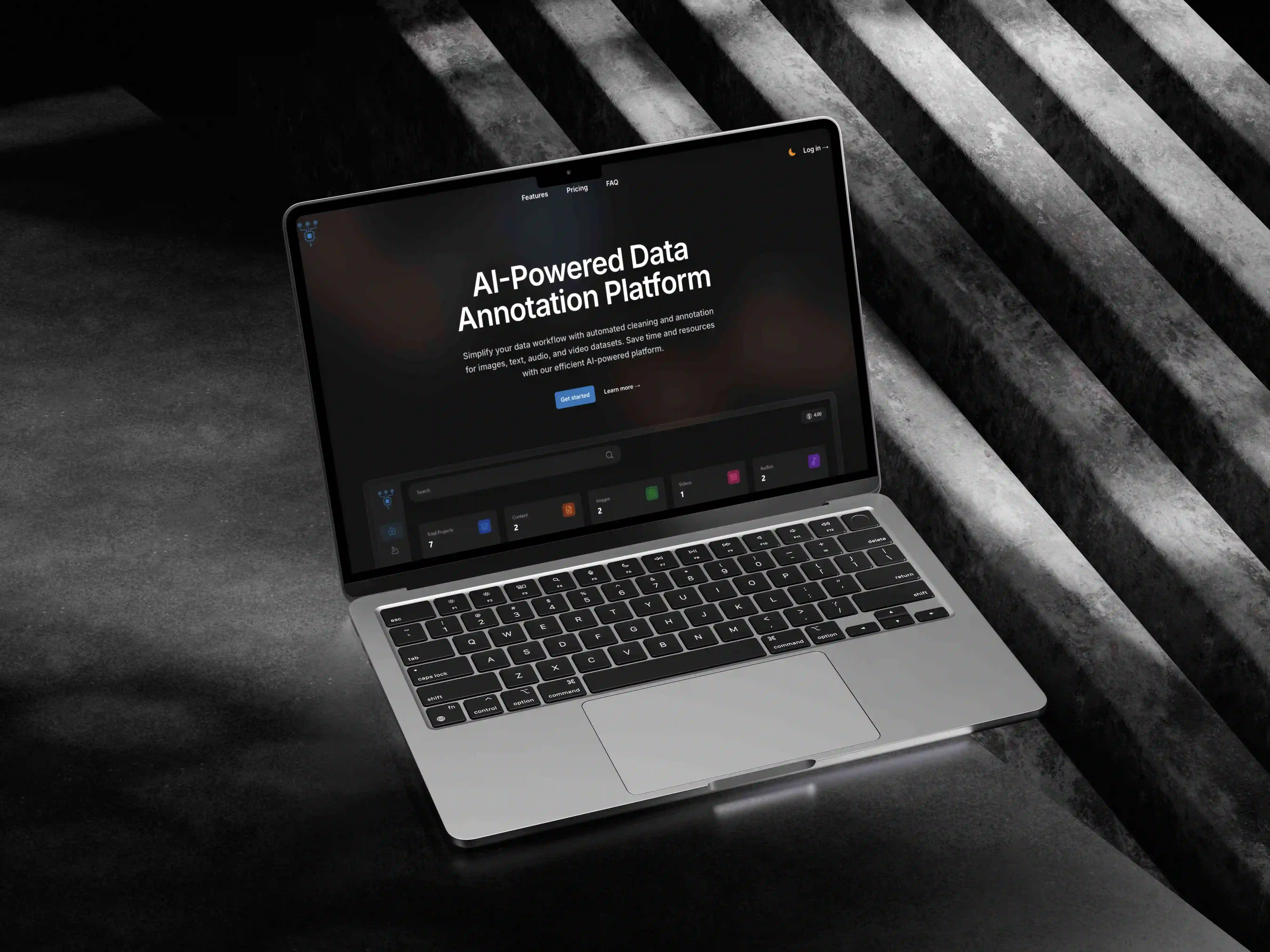
Track every project and manage subscription quotas from a single control center.
Automated cleaning and annotation across text, image, audio, and video files.
Automated cleaning and tagging powered by AI, updated the moment data comes in.
Advanced AI models handle sentiment analysis, object detection, and transcription automatically.
Every annotation is counted in real time, with alerts before limits are reached.
Data gets cleaned, categorized, and tagged without manual review.
A dashboard surfaces usage analytics and project logs at a glance.
Finalized, ML-ready datasets download directly from the platform.
Challenges
The manual bottleneck
Three problems stood between Datanation and the platform they envisioned. Here's what we had to solve.
The manual bottleneck
Preparing data is usually a massive headache. Teams spend hundreds of hours manually removing duplicates, filling missing values, and tagging visual or text elements. Datanation needed a way to pull all this scattered manual work into one automated, reliable engine.
Every hour spent cleaning a dataset by hand was an hour not spent training or shipping a model. The manual review process also introduced inconsistency, since two people rarely tagged the same edge case the same way.
Handling multiple file formats
Most existing analysis tools are built for specific niches. Users hit a wall when trying to process a mix of video frames, audio recordings, and long form text in one place. The challenge was building a backend capable of processing all these file types without switching applications.
A team working across modalities needed one system that understood a transcript, a product photo, and a customer call recording equally well, instead of stitching together three specialized tools with three different export formats.
Managing usage and scale
Processing AI tasks is computationally heavy. Datanation wanted to offer a subscription model, which meant they needed strict controls over how much data users could run through the system — tracking individual annotations, not just file uploads.
A single video upload could generate thousands of individual annotations behind the scenes, so counting by file alone would have badly undercounted real usage. The system needed to meter at the level customers actually pay for.
Solutions
Here's what we built
Automated AI processing
A backend integration using AWS Rekognition, ElevenLabs, and Langchain. Users upload raw datasets and the system immediately runs them through advanced AI models for sentiment analysis, object detection, and transcription.
Smart quota management
A real time counting system built into the user dashboard. It tracks every annotation, sends alerts at 80 percent capacity, and automatically pauses processing when a subscription limit is met.
A purpose built user dashboard
A central command center for dataset management, with dedicated spaces for file uploads, usage analytics, and downloadable reports.
Results
From raw files to instant usability
LogicLeaps helped transform DataNation from an idea into a fully functioning ecosystem. The project proves that when you eliminate manual repetitive tasks, you amplify a team's real output.
Got a product idea worth protecting?
Whether it's dataset preparation or an entirely different industry, we build platforms that turn manual work into automated pipelines.